
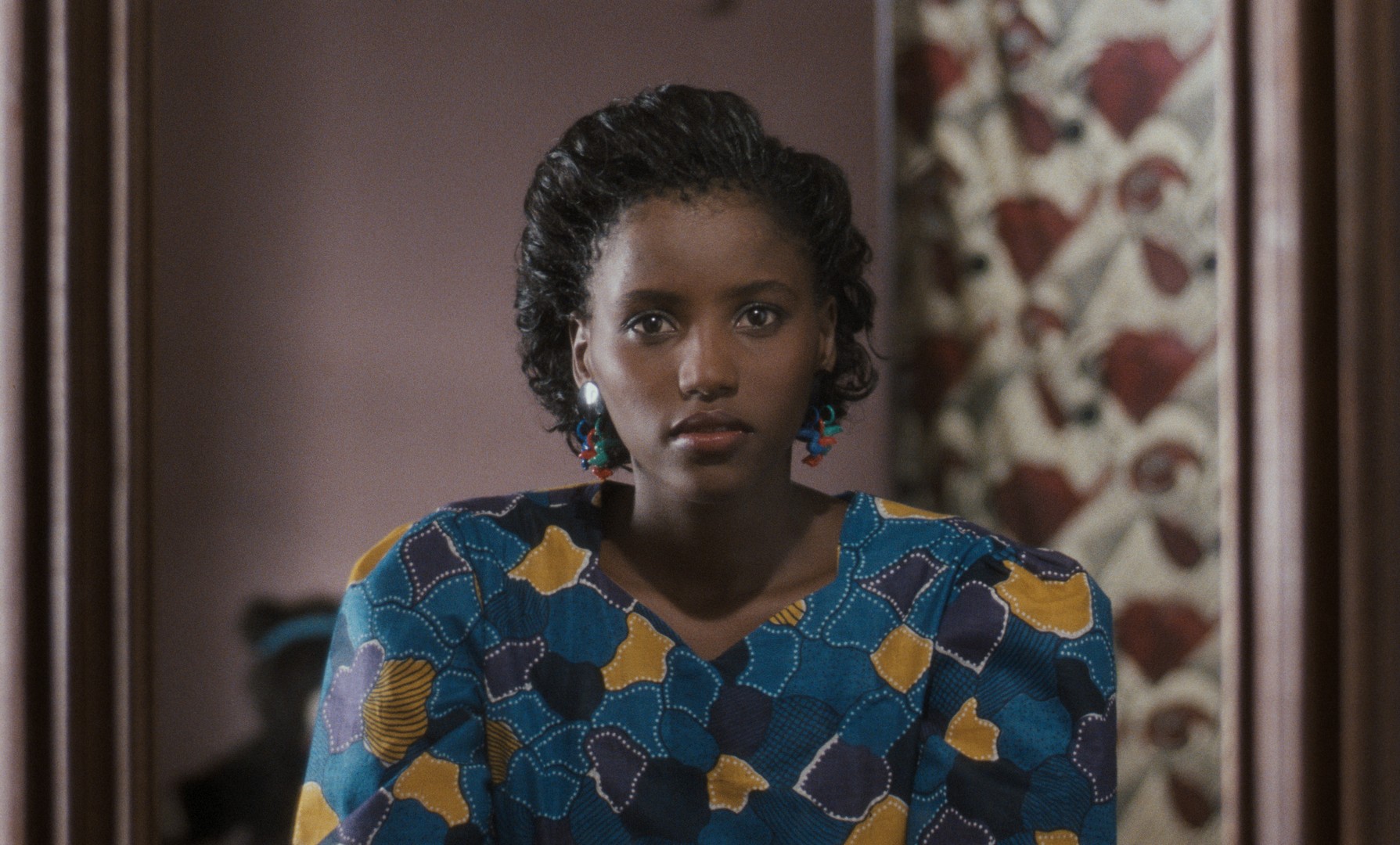
The newly restored digital version of The Blue Eyes of Yonta (Udju Azul di Yonta, 1992), the second feature film by Flora Gomes and a co-production between Guinea-Bissau and Portugal, will have its world premiere in the Venice Classics section of the 83rd Venice International Film Festival, taking place from 2 to 12 September 2026.
Made only a few years after Mortu Nega, The Blue Eyes of Yonta follows a generation of young people in Guinea-Bissau who came of age after independence, caught between the ideals of the liberation struggle and the promises of modernity. With honesty, gentle humour and great sensitivity, Flora Gomes crafts a vibrant portrait of a country in transition, reflecting on identity, colonial memory and the aspirations of a generation called upon to imagine its future.
Flora Gomes (Cadique, Guinea-Bissau, 1949) is one of Africa’s most important filmmakers and a leading figure in the cinema of Guinea-Bissau. He studied filmmaking at the Cuban Institute of Cinematographic Art and Industry (ICAIC) in Havana under Santiago Álvarez, before continuing his training in Senegal with Paulin Soumanou Vieyra, one of the pioneers of African cinema. Following Guinea-Bissau’s independence, he worked as a reporter, cameraman and at the Ministry of Information, beginning his career with documentaries connected to the liberation struggle and the construction of the new nation. His first feature, Mortu Nega (1988), is widely regarded as a foundational work of Guinean cinema and a landmark of African filmmaking. He consolidated his international reputation with The Blue Eyes of Yonta (1992), Po di Sangui (1996) and Nha Fala (2002), all of which were presented and honoured at major festivals including Cannes, Venice, FESPACO and Carthage. Throughout his career, Gomes has explored themes of independence, cultural identity, memory, the colonial legacy and the relationship between tradition and modernity through a cinematic language that combines political reflection, humour, poetry and the richness of African oral traditions. His work has received numerous international distinctions in recognition of his outstanding contribution to cinema.
This new restoration is based on a 4K wet-gate scan of the original 35mm camera negative, preserved by Cinemateca Portuguesa. The soundtrack was digitised from the original magnetic sound elements, also preserved by the Cinemateca. The 4K scanning, digital image restoration and colour grading were carried out in 2025 through a partnership between Cineric Portugal and Irmalucia Visual Effects, while the digital sound restoration was undertaken by BillyBoom Studio using a distribution print as reference.
Created in 2012, the Venice Classics section presents each year a selection of the most significant restorations of world cinema classics undertaken by film archives, cinematheques, cultural institutions and production companies from around the world.